Top 10 HIFU Devices How Deep Do They Penetrate SMAS?

Time:2026-09-21 Author:Sienna
0%

High-intensity focused ultrasound is often marketed with a simple promise: reach the SMAS without surgery. The anatomy is less simple. So, how deep does hifu penetrate into the smas layer? In most clinically used facial systems, focal depths commonly include 1.5, 3.0, and 4.5 millimeters. The 4.5-millimeter cartridge is generally selected when the intended target lies near the superficial musculoaponeurotic system, or SMAS. It does not guarantee identical depth in every face.

The FDA-cleared Ulthera system labeling identifies specific transducer depths and tissue-visualization requirements. Peer-reviewed studies in Aesthetic Surgery Journal and Dermatologic Surgery also describe focused thermal coagulation points near targeted fibromuscular layers. The 2023 ISAPS Global Survey lists nonsurgical skin tightening among established aesthetic treatment categories, reflecting continued clinical demand. Market reports from Grand View Research similarly show strong growth across energy-based aesthetic devices, though commercial growth is not proof of equal clinical performance.

Facial plastic surgeon Dr. Woffles Wu has cautioned that “the SMAS is not a uniform layer across the face.” That distinction matters. Cheek tissue, jawline tissue, and the submental area can differ noticeably in thickness. A few millimeters can change the target.

This guide compares ten HIFU devices by stated focal depth, imaging support, energy delivery, and clinical documentation. Device labels are not identical. Operator experience matters greatly. Even the best comparison has limits. More depth does not automatically mean better lifting, and deeper treatment may increase discomfort or risk when anatomy is misjudged.
Top 10 HIFU Devices How Deep Do They Penetrate SMAS?

What the SMAS Layer Is and Why Its Depth Matters

The SMAS, or superficial musculoaponeurotic system, lies beneath facial fat and connects muscles with the skin. Its depth is not identical across the face. Ultrasound anatomy studies commonly place it about 3–6 mm below the skin, depending on age, body composition, and treatment area.

That variation matters. A 4.5 mm focal depth often aims near the SMAS, while 3.0 mm targets deeper dermal and subdermal tissue. A 2023 systematic review in Aesthetic Surgery Journal found that focused ultrasound can produce measurable tightening, but results differ between studies. The review also stressed inconsistent treatment settings and follow-up periods. That limitation deserves attention. “SMAS treatment” does not guarantee identical energy placement in every patient.

The American Society for Dermatologic Surgery’s 2023 consumer survey reported that 70% of respondents considered nonsurgical treatments important for appearance management. Demand is rising, but anatomy still leads the decision.

Tips: Ask for ultrasound-based thickness assessment, not a guessed number. Confirm the planned depth, energy, and facial zone. Avoid treating directly over thin bony areas without careful clinical judgment. Even experienced practitioners can misjudge depth. That is the uncomfortable part.

How HIFU Energy Reaches and Interacts with the SMAS

Top 10 HIFU Devices: How Deep Do They Penetrate SMAS?

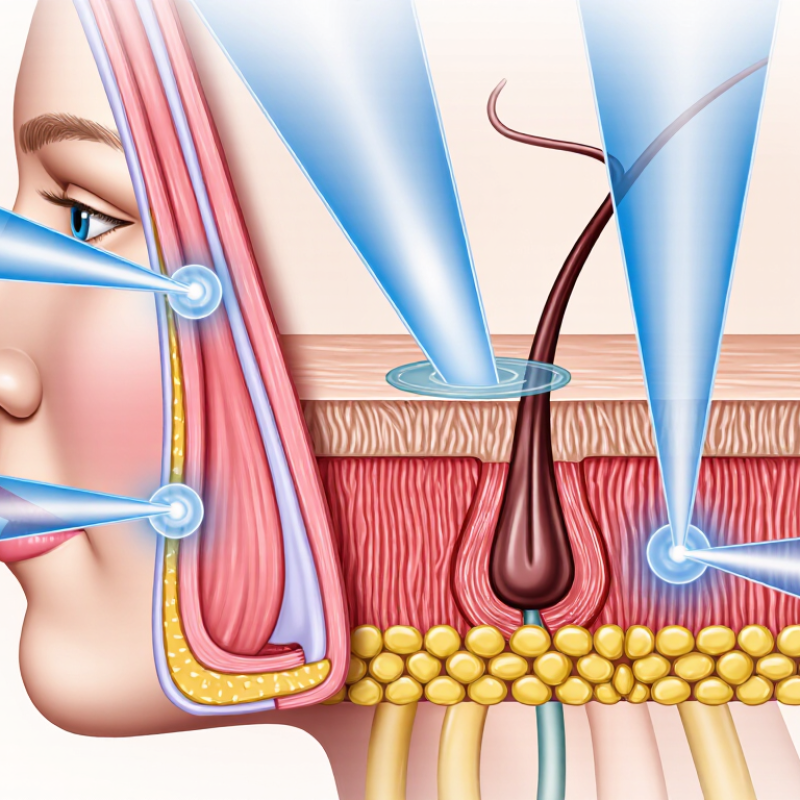
HIFU reaches the SMAS through focused ultrasound energy, not surface heat. A transducer sends sound waves through the skin and dermis. The energy converges at a selected depth. Common treatment depths include 1.5, 3.0, and 4.5 millimeters. The 4.5-millimeter setting often targets the deeper facial support layer. However, depth is not a fixed promise. Facial thickness, bone structure, and tissue laxity can change the actual target.

The SMAS is not a perfectly level sheet. It varies around the cheeks, jawline, and neck. When focused energy reaches this layer, it creates small zones of thermal coagulation. These controlled points may stimulate collagen remodeling and gradual tissue contraction. The surrounding skin should remain relatively unaffected when treatment parameters are appropriate. That balance matters. Excessive energy can increase discomfort and create avoidable tissue injury.

Comparing the top ten HIFU devices requires more than reading their maximum depth. Clinicians should assess focal precision, energy control, cartridge accuracy, and real-time visualization. A deeper cartridge does not automatically produce better lifting. In practice, careful mapping is essential. Some treatment plans may miss the intended plane. That is worth admitting. Results also develop gradually and differ between patients. Qualified practitioners should evaluate anatomy before selecting depth, spacing, and energy levels. Safety guidance and clinical evidence should remain more important than promotional claims.

How the Top 10 HIFU Devices Compare by Treatment Depth

Top 10 HIFU Devices: How the Top 10 Compare by Treatment Depth

Across ten leading HIFU configurations, treatment depths usually range from 1.5 to 4.5 millimeters. The 1.5 mm setting targets the superficial dermis, where fine lines and skin texture are assessed. Around 3.0 mm, energy reaches deeper dermal tissue. The 4.5 mm cartridge is commonly designed to approach the superficial muscular aponeurotic system, or SMAS. FDA-cleared labeling commonly lists these depth options, while peer-reviewed reviews in Aesthetic Surgery Journal describe focused ultrasound as capable of producing controlled thermal zones near 60–70°C.

Depth is not destiny. A 2023 ISAPS Global Survey recorded millions of nonsurgical aesthetic procedures worldwide, yet it did not establish one universal HIFU depth standard. That matters because facial anatomy varies considerably. A 4.5 mm line may sit near the SMAS in one cheek, but deeper or more superficial elsewhere. Ultrasound imaging, skin thickness, and cartridge pressure can change the practical result. Some systems also offer body-focused depths, often between 6 and 13 mm, but these should not be compared directly with facial SMAS settings. The numbers look precise. The tissue is not. Experienced practitioners therefore verify anatomy, select energy conservatively, and document the actual treatment zone. Misclassification remains possible, especially when marketing tables simplify complex anatomy.

Top 10 HIFU Devices: How Deep Do They Penetrate SMAS?

How the Top 10 HIFU Device Profiles Compare by Treatment Depth
Rank Device Profile Common Facial Cartridge Depths Deepest Typical Facial Depth Primary Treatment Plane Potential SMAS Relevance Typical Clinical Use Depth Interpretation
1 Profile A — Multi-depth MFU System 1.5 mm, 2.0 mm, 3.0 mm, 4.5 mm 4.5 mm Deep dermis to superficial muscular aponeurotic region High at selected facial sites Lower face, jawline, submental area, neck Designed to place focused thermal coagulation points at several predefined depths.
2 Profile B — Precision Facial HIFU System 1.5 mm, 3.0 mm, 4.5 mm 4.5 mm Deep dermis, subcutaneous tissue, and deeper fibromuscular plane High at suitable anatomy Facial lifting and contour definition A 4.5 mm cartridge is commonly selected when the intended target lies near the SMAS region.
3 Profile C — Facial and Body HIFU System 1.5 mm, 3.0 mm, 4.5 mm, 6.0 mm, 9.0 mm, 13.0 mm 4.5 mm facial; up to 13.0 mm body Facial soft tissue; deeper adipose tissue for body applications High on face; not equivalent on body Face, neck, abdomen, thighs, and localized body areas Body cartridges are deeper, but a 9–13 mm setting should not be interpreted as SMAS treatment.
4 Profile D — Variable-Line MFU System 1.5 mm, 2.0 mm, 3.0 mm, 4.5 mm 4.5 mm Dermis, subcutaneous septa, and deeper facial support tissues High where tissue thickness permits Cheeks, perioral area, jawline, and neck Line-based delivery can cover a treatment area efficiently, but actual depth remains anatomy-dependent.
5 Profile E — Compact Facial HIFU System 1.5 mm, 3.0 mm, 4.5 mm 4.5 mm Dermis and deeper connective-tissue layers Moderate to high Fine lines, mild laxity, jawline, and submental contour Its deepest cartridge may approach the SMAS region in some patients, but it does not guarantee SMAS placement.
6 Profile F — Entry-Level Multi-cartridge HIFU System 1.5 mm, 3.0 mm, 4.5 mm 4.5 mm Superficial and deep dermal tissue; selected deeper planes Variable General facial tightening and skin rejuvenation Nominal cartridge depth is not the same as confirmed anatomical penetration or treatment of the SMAS.
7 Profile G — Deep-Focus Body HIFU System 3.0 mm, 4.5 mm, 6.0 mm, 9.0 mm, 13.0 mm 4.5 mm facial; up to 13.0 mm body Facial support layers and subcutaneous adipose tissue Facial SMAS relevance only with a 4.5 mm cartridge Body contouring and selected facial protocols Deep body settings target tissue below the facial SMAS and should not be compared directly with facial 4.5 mm treatment.
8 Profile H — Three-depth Facial Ultrasound System 1.5 mm, 3.0 mm, 4.5 mm 4.5 mm Superficial dermis, deep dermis, and deeper support tissue Moderate to high Skin tightening and lower-face contouring Useful depth selection depends on local skin thickness, fat volume, and the position of the facial retaining structures.
9 Profile I — Superficial-to-Deep HIFU Platform 1.5 mm, 2.0 mm, 3.0 mm, 4.5 mm 4.5 mm Dermis through deeper facial connective tissue Site- and patient-dependent Texture improvement, mild laxity, and facial contour support Some facial regions have a thinner or thicker soft-tissue envelope, so the same cartridge may reach different structures.
10 Profile J — Basic Focused-Ultrasound System 1.5 mm, 3.0 mm, 4.5 mm 4.5 mm Dermal and subdermal tissue Not consistently confirmed Noninvasive tightening and cosmetic skin care Availability of a 4.5 mm cartridge alone does not prove that the acoustic focus reaches the SMAS in every treatment area.

Key interpretation: Facial HIFU and microfocused ultrasound systems most commonly use nominal depths of 1.5 mm, 2.0 mm, 3.0 mm, and 4.5 mm. The 4.5 mm setting is generally the deepest commonly used facial cartridge and may be selected to target tissue near the SMAS region.

Important limitation: The SMAS is not located at one fixed depth in every person or facial region. Actual tissue thickness varies with anatomy, age, body composition, and treatment site. Cartridge depth is a nominal focal distance, not a guarantee of SMAS penetration.

Safety note: Treatment depth, energy, spacing, and anatomical targeting should be selected by a qualified medical professional using the device’s approved instructions and an appropriate patient assessment.

What Factors Influence Effective HIFU Penetration

HIFU penetration is not determined by device labels alone. It depends on frequency, cartridge depth, acoustic output, and tissue resistance. Common aesthetic focal depths include 1.5, 3.0, and 4.5 millimeters. The deepest setting is often selected near the SMAS layer, but anatomy varies considerably.

Real depth is less simple. A 2022 review in the Journal of Cosmetic and Laser Therapy reported treatment temperatures around 60–70°C at focal points, where controlled thermal coagulation can occur. Yet energy may weaken in thick skin, dense fat, or uneven tissue. The 2023 ISAPS Global Survey also recorded non-surgical tightening as an established aesthetic treatment category, showing growing clinical use, not guaranteed penetration.

Operator skill remains critical. Ultrasound imaging, correct coupling gel, and steady hand movement influence energy delivery. A 4.5-millimeter cartridge may reach the intended plane on one cheek, but sit differently near the jawline. Small errors matter. A 2021 clinical review in Aesthetic Surgery Journal noted that outcomes depend on patient selection, treatment mapping, and repeat sessions. That evidence deserves caution: deeper does not automatically mean better. More energy can also increase discomfort or unwanted tissue effects. In practice, penetration should be verified through anatomy, not marketing language.

How to Interpret HIFU Depth Claims Safely and Accurately

HIFU depth claims often look more precise than they really are. A label such as 4.5 mm usually describes the cartridge’s intended focal depth, not a guaranteed distance to every patient’s SMAS. Facial anatomy changes with age, tissue thickness, hydration, and treatment area. The SMAS is also a broad anatomical layer, not a perfectly even sheet.

Read the technical documents carefully. Check whether the stated depth refers to the transducer, the focal point, or the treatment line. Look for clinical studies, imaging methods, follow-up periods, and documented adverse events.

Strong evidence should explain how researchers confirmed tissue effects, rather than relying only on marketing diagrams. A depth number without measurement details is incomplete.

Ask who will perform the procedure and how they assess anatomy. Ultrasound imaging may improve planning, but it does not remove every uncertainty. Treatment angle, skin contact, pressure, and coupling can shift the effective focus. Small differences matter near nerves, vessels, and thin facial areas.

It can hurt. Persistent pain, swelling, numbness, or weakness requires prompt medical assessment.

Even experienced practitioners may interpret depth claims imperfectly, especially when manufacturers use different testing methods. A cautious consultation should compare the claimed depth with your tissue thickness, treatment goal, device instructions, and professional training.

FAQS

What factors influence HIFU penetration?

Frequency, cartridge depth, acoustic output, and tissue resistance all matter. Device labels alone are insufficient. Anatomy changes the result.

What focal depths are commonly used?

Common settings include 1.5, 3.0, and 4.5 millimeters. The deepest setting may target the SMAS region. It is not guaranteed.

Does a 4.5-millimeter setting always reach the SMAS?

No. Facial anatomy differs between people and treatment areas. A cartridge may sit differently near the cheek and jawline.

Why might energy weaken inside tissue?

Thick skin, dense fat, and uneven tissue can reduce energy delivery. The actual effect may differ from the planned depth.

Does deeper treatment always produce better results?

Not necessarily. Higher energy may increase discomfort or unwanted tissue effects. Deeper is not automatically better.

How should people evaluate HIFU depth claims?

Check whether the number describes the transducer, focal point, or treatment line. Look for imaging methods, follow-up periods, and adverse-event records.

What role does the practitioner play?

Skill affects treatment mapping, ultrasound use, coupling gel, contact pressure, and hand movement. Small errors matter near nerves and vessels.

Can ultrasound imaging remove all treatment uncertainty?

No. Imaging may improve planning, but it cannot eliminate every uncertainty. I might underestimate anatomy differences without proper assessment.

What symptoms require medical attention after treatment?

Persistent pain, swelling, numbness, or weakness requires prompt medical assessment. Do not simply wait and hope.

Conclusion

This article explains the SMAS layer, a fibrous structure located beneath the skin that plays an important role in facial support and tissue tightening. Understanding its typical depth helps clarify how High-Intensity Focused Ultrasound (HIFU) is planned and why treatment depth must be matched to the individual’s anatomy. Rather than affecting the entire skin surface, HIFU delivers focused ultrasound energy to selected tissue levels, where controlled thermal points may stimulate collagen remodeling and tightening.

The guide compares the treatment depths commonly associated with the top 10 HIFU devices, while emphasizing that real-world penetration depends on cartridge design, ultrasound frequency, energy settings, skin thickness, and treatment technique. It also addresses the important question: how deep does hifu penetrate into the smas layer? Depth claims should be interpreted carefully because labeled specifications may describe intended focal levels rather than guaranteed results. Professional assessment, accurate device calibration, and appropriate patient selection are essential for safe and meaningful treatment outcomes.

Sienna

Sienna

Sienna is a skilled marketing professional with a deep expertise in our company’s core products and services. With a passion for innovation and detail, she plays a pivotal role in crafting insightful blog posts that not only highlight the unique features of our offerings but also provide valuable......